
True riches
VI Lent Tuesday - Genesis 31: 3-16

And the Lord said to Jacob, Return to the land of thy father, and to thy family, and I will be with thee. And Jacob sent and called Lea and Rachel to the plain where the flocks were. And he said to them, I see the face of your father, that it is not toward me as before, but the God of my father was with me. And ye too know that with all my might I have served your father. But your father deceived me, and changed my wages for the ten lambs, yet God gave him not power to hurt me. If he should say thus, The speckled shall be thy reward, then all the cattle would bear speckled; and if he should say, The white shall be thy reward, then would all the cattle bear white. So God has taken away all the cattle of your father, and given them to me. And it came to pass when the cattle conceived and were with young, that I beheld with mine eyes in sleep, and behold the he-goats and the rams leaping on the sheep and the she-goats, speckled and variegated and spotted with ash-coloured spots. And the angel of God said to me in a dream, Jacob; and I said, What is it? And he said, Look up with thine eyes, and behold the he-goats and the rams leaping on the sheep and the she-goats, speckled and variegated and spotted with ash-coloured spots; for I have seen all things that Laban does to thee. I am God that appeared to thee in the place of God where thou anointedst a pillar to me, and vowedst to me there a vow; now then arise and depart out of this land, depart into the land of thy nativity, and I will be with thee. And Rachel and Lea answered and said to him, Have we yet a part or inheritance in the house of our father? Are we not considered strangers by him? for he has sold us, and quite devoured our money. All the wealth and the glory which God has taken from our father, it shall be ours and our children’s; now then do whatsoever God has said to thee. – Genesis 31:3-16
In fourteen years, God has given Jacob both domestic happiness and material success, despite all the efforts of Laban, his crafty father-in-law, to cheat him. The Lord has demonstrated, once again, that man’s cleverness is powerless against His wisdom and His will. God willed to make Jacob a great patriarch in His plan of salvation for mankind, and He has acted according to His will.
Jacob’s new status as a great householder gives him what today we call “financial freedom”: he is his own master, not beholden to an employer or creditor who can take the bread out of his mouth at any moment. God alone, the Master of wind, weather, the tides of warring nations, and the health of man and beast, can now give or take away his prosperity. He has obtained his freedom, however, not by going around or against God’s will, but by fulfilling it. He has done his part in the plan of salvation; he has conformed his will to the will of God.
Jacob’s earthly wealth provides a typos,a prophetic image, of the true wealth the Lord wants to give us, new and permanent properties of soul and body, gifts of His uncreated grace: pure prayer, harmony with God’s creation, lasting peace of heart – all the joys of friendship with God. Jacob’s earthly freedom provides a prophetic image of the eternal freedom God intends for us, the freedom of the sons of God: freedom from sin, the devil, death, and hell. We must conform our wills to the will of God, and we will become free.
A fatally mistaken idea about freedom grips the minds of men, who equate freedom with the permission to disobey God and get away with it. They want to make their own rules and create their own reality. It does not seem to occur to them that the further they go in this direction, the more miserable they become. This present misery only faintly presages what is in store for them. What is doubtless going to happen to them after they die, apart from an unrevealed miracle of God’s mercy upon which no one can rely, is something we cannot – and would prefer not – to imagine.
Mentored by Satan, men mistakenly imagine that the permission to do evil is inherent in having a will, in being free and rational creatures, but it is not. Our natural will is most free when conformed completely to God’s will; we are most ourselves, most free, most rational, and possessed of will in its ultimate degree, when we do God’s will at every moment. What men mistakenly call “free will” is what St. Maximus the Confessor identifies as the “gnomic” will – a diseased condition of the will based on ignorance, conflicting opinions, and moral weakness, the result of the Fall. It is this condition of the will that we experience every day when our choice wavers between good and evil, between God’s Law and the law of sin and death.
We overcome the stress and misery of this wavering, uncertain state by unrelenting work on ourselves. Yes, we obtain the glorious freedom of the sons of God by God’s gift, but also we must labor. We find an example in Jacob, who did indeed receive all as gift from God but also was not idle. Last week we recalled his labors while chanting the Great Canon:
In privation Jacob the Patriarch endured the burning heat by day and the frost by night, making daily gains of sheep and cattle, shepherding, wrestling, and serving, to win his two wives. By the two wives, understand action and knowledge in contemplation. Leah is action, for she had many children; and Rachel is knowledge, for she endured great toil. And without toil, O my soul, neither action nor contemplation will succeed. – from Ode Four of the Great Canon of St. Andrew of Crete
May the sweetness of Holy Pascha that we will soon enjoy give us a taste of the eternal wealth and freedom that cannot be taken away. May it encourage us to serve the Lord in active virtue and find rest in Him through prayer. Let us conform our wills to His holy, peaceful, and perfect will, and we will find glorious rest, the freedom of the sons of God.
This commentary was taken from The Eternal Sacrifice: The Genesis Readings for Great Lent by Fr. Steven Allen. You can order a copy from Lulu at http://www.lulu.com/spotlight/FrStevenAllen
Today’s reading from Esaias, with commentary:
Thus saith the Lord: It is a great thing for thee to be called my servant, to establish the tribes of Jacob, and to recover the dispersion of Israel: behold, I have given thee for the covenant of a race, for a light of the Gentiles, that thou shouldest be for salvation to the end of the earth. 7 Thus saith the Lord that delivered thee, the God of Israel, Sanctify him that despises his life, him that is abhorred by the nations that are the servants of princes: kings shall behold him, and princes shall arise, and shall worship him, for the Lord’s sake: for the Holy One of Israel is faithful, and I have chosen thee. 8 Thus saith the Lord, In an acceptable time have I heard thee, and in a day of salvation have I succored thee: and I have formed thee, and given thee for a covenant of the nations, to establish the earth, and to cause to inherit the desert heritages: 9 saying to them that are in bonds, Go forth; and bidding them that are in darkness shew themselves. They shall be fed in all the ways, and in all the paths shall be their pasture. 10 They shall not hunger, neither shall they thirst; neither shall the heat nor the sun smite them; but he that has mercy on them shall comfort them, and by fountains of waters shall he lead them. - Esaias 49: 6-10
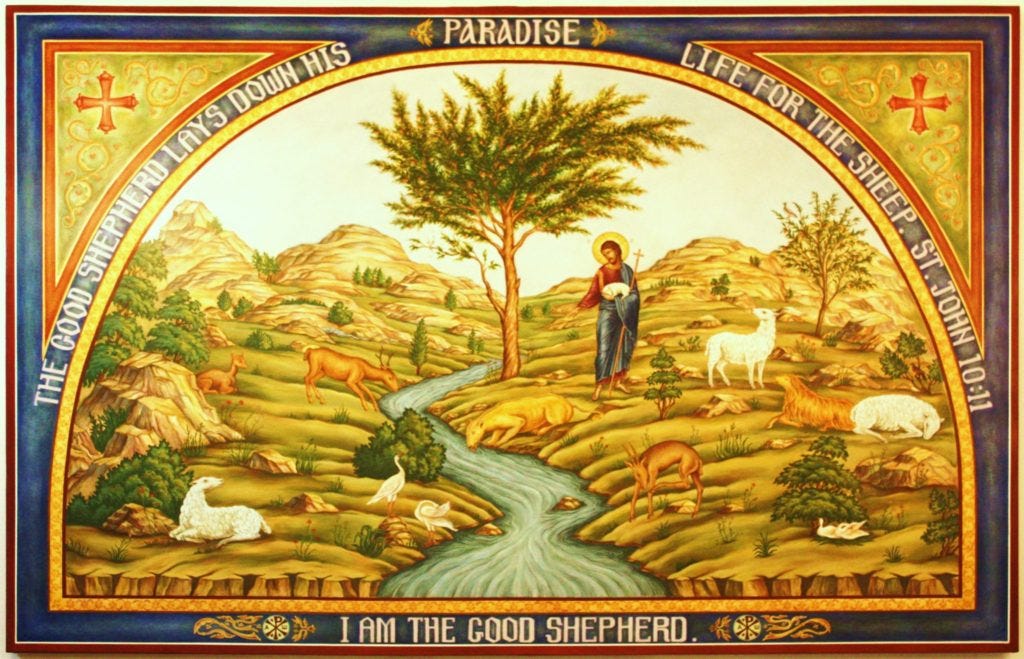
Today’s reading is one of many specifically Christological passages in the Prophet Esaias, that is, the passages which speak directly of the person of Christ and the Economy of the Incarnation: His divinity and humanity, and His messianic mission of the salvation of mankind through His suffering and glorification. Here God the Father is addressing His Son, revealing several aspects of His mission: He will be the New Covenant with God for both the Israelites and the Gentiles; He will “despise his life”, i.e., He will freely give Himself over to death; though “abhorred by the nations,” the kings and princes of the nations converted to Christ will one day worship Him; He will say to those in bonds and in darkness, that is, those enslaved to the death, devil, and hell, “Go forth,” when He descends into Hades and looses the captives there; He shall feed them as a Good Shepherd in all the paths of this life, with His Precious Body and Blood; and, finally, He shall establish them forever in the eternal Kingdom, where “neither shall the heat nor the sun smite them,” and they will rest forever by the “fountains of waters” of Paradise.
Words from the verse immediately before the beginning of today’s reading, verse five, “thus saith the Lord that formed me from the womb to be his own servant,” were among the passages that the Arians misinterpreted in order to argue that the eternal Word was not truly God but a creature. The language of this verse, they claimed, was figurative, the “womb” spoken of being not the womb of the Virgin but the abyss of the Godhead. Saying that He was “formed,” they said, meant that the pre-eternal Word was not truly eternal but came into being in time. Other verses in the Old Testament were similarly twisted by them to support their heresy. St. Gregory of Nyssa disposes of their false teaching with his customary insight and ease of expression, explaining that all the verses in the Old Testament that refer to the Son being “made” do not refer to His eternal Godhead but to His Incarnate economy, in which He was made man. His humanity is created; His divinity is uncreated, being the divine nature He shares with the Father and the Spirit.
In response to those who quote the passage from Proverbs, “the Lord created me (Proverbs 8:22), and claim that it makes a strong case that the Creator and Maker of all things was created, one should say that the only-begotten God was made many things for us. For he was the Word and was made flesh; he was God and was made man; he was without a body and was made a body. Further, he was made sin (II Corinthians 5:21) and a curse (II Cor. 5:21), and a stone (Acts 4:11), and an axe (Matt. 3:10), and bread (John 6:32-33), and a lamb (John 1:29), and a way (John 14:6), and a door (John 10:7), and a rock (I Cor. 10:4). He was none of these things by nature, but he became them for us during his sojourn among us.
Just as he is the Word who was made flesh for our sake and God who was made man, so he is the Creator who was made a creature for our sake. As he said through the prophet: “Thus saith the Lord that formed me from the womb to be his own servant (Is. 49:5).” And through Solomon he also said: “The Lord created me the beginning of his ways, for his works (Proverbs 8:22”….the one who was “created the beginning of his ways” is not God but the man in whom God was revealed in order to renew for mankind the way of salvation which had been corrupted. Since we recognize two things in Christ, the one divine, the other human…we attribute that which is eternal to the godhead, and that which is created we ascribe to his human nature. As he was “formed in the womb as a servant” according to the prophet [Esaias], so according to Solomon he was revealed in the flesh by means of this servile creation. So, when some [i.e., the Arians] contend, “If he always was, he was not begotten, and if he was begotten there was a time when he was not,” they should learn that one should not ascribe to his divine nature those attributes that belong to his birth in the flesh. – St. Gregory of Nyssa, On Faith, to Simplicius
Concerning the words from verse nine, “…saying to them that are in bonds, Go forth; and bidding them that are in darkness shew themselves,” St. Cyril of Alexandria says the following:
That which had resisted being conquered – Death! – was conquered, corruption was made into something new, the seemingly invincible evil routed. The relentless and insatiable desire of Hades for yet more dead had no one to welcome, and learned – much to its regret – what it had never had to learn before. For now Hades no longer had the power to snatch those who are yet dying, it had to vomit forth those whom it had already caught, and by the power of our Savior it was left to endure splendid isolation. For Christ came saying to those in bonds, “Come out,” and to those in darkness, “see the light of day.” And after he preached to the spirits in prison (I Peter 3:19), he mounted up victorious, raising his own “temple” (John 2:19-21) as a kind of “first fruits” (I Cor. 15:20) of our hope. He led the way for our nature to rise from the dead and for us to be showered with other good gifts. – St. Cyril of Alexandria, Festal Letter V.
Next week we shall behold both the humiliation and death of the God-Man according his human nature, as well as the triumph of that same nature that He voluntarily shared with us, in His glorious resurrection. Let us use this week well, preparing our hearts, through attentiveness, for this annual renewal of our pledge of eternal life.
O Lord Who endured all things for us, and Who glorified us by Thy Resurrection, glory be to Thee.
Today’s reading from Proverbs, with commentary:
3 To do justly and to speak truth, are more pleasing to God than the blood of sacrifices. 4 A high-minded man is stout-hearted in his pride; and the lamp of the wicked is sin. 5 6 He that gathers treasures with a lying tongue pursues vanity on to the snares of death. 7 Destruction shall lodge with the ungodly; for they refuse to do justly. 8 To the perverse God sends crooked paths; for his works are pure and right. 9 It is better to dwell in a corner on the house-top, than in plastered rooms with unrighteousness, and in an open house. 10 The soul of the ungodly shall not be pitied by any man. 11 When an intemperate man is punished the simple becomes wiser: and a wise man understanding will receive knowledge. 12 A righteous man understands the hearts of the ungodly: and despises the ungodly for their wickedness. 13 He that stops his ears from hearing the poor, himself also shall cry, and there shall be none to hear him. 14 A secret gift calms anger: but he that forbears to give stirs up strong wrath. 15 It is the joy of the righteous to do judgement: but a holy man is abominable with evil-doers. 16 A man that wanders out of the way of righteousness, shall rest in the congregation of giants. 17 A poor man loves mirth, loving wine and oil in abundance; 18 and a transgressor is the abomination of a righteous man. 19 It is better to dwell in a wilderness than with a quarrelsome and talkative and passionate woman. 20 A desirable treasure will rest on the mouth of the wise; but foolish men will swallow it up. 21 The way of righteousness and mercy will find life and glory. - Proverbs 21: 3 – 21
In verse eight, we read, “To the perverse God sends crooked paths.” St. John Chrysostom quotes this verse of Proverbs in his commentary on chapter five of the Gospel according to St. John, to warn his listeners that, if they persist in misusing their will to do evil, they will also destroy their mind’s ability to know the truth. The context is Our Lord’s dispute with the unbelieving Jews who refused to accept Him; they could not understand Who he was, because their deeds were evil and therefore their minds and hearts were darkened. Here is what St. Chrysostom says:
Wherefore we must cast out all wickedness from our souls, and never more contrive any deceit; for, says one, “To the perverse God sends crooked paths” (Proverbs 21:8); and, “The holy spirit of discipline will flee deceit, and remove from thoughts that are without understanding.” Wisdom 1: 5For nothing makes men so foolish as wickedness since when a man is treacherous, unfair, ungrateful, (these are different forms of wickedness) when without having been wronged he grieves another, when he weaves deceits, how shall he not exhibit an example of excessive folly? Again, nothing makes men so wise as virtue; it renders them thankful and fair-minded, merciful, mild, gentle, and candid; it is wont to be the mother of all other blessings. And what is more understanding than one so disposed? For virtue is the very spring and root of prudence, just as all wickedness has its beginning in folly. For, the insolent man and the angry become the prey of their respective passions from lack of wisdom; on which account the prophet said, “There is no soundness in my flesh: my wounds stink and are corrupt because of my foolishness” (Psalm 38: 3-4): showing that all sin has its beginning in folly: and so the virtuous man who has the fear of God is more understanding than any; wherefore a wise man has said, “The fear of the Lord is the beginning of wisdom.” (Proverbs 1: 7) If then to fear God is to have wisdom, and the wicked man has not that fear, he is deprived of that which is wisdom indeed — and deprived of that which is wisdom indeed, he is more foolish than any. And yet many admire the wicked as being able to do injustice and harm, not knowing that they ought to deem them wretched above all men, who thinking to injure others thrust the sword against themselves — an act of extremest folly, that a man should strike himself and not even know that he does so, but should think that he is injuring another while he is killing himself. – St. John Chrysostom, Commentary on John, Homily 41
Even the pagan philosophers understood that the passions cloud a man’s understanding and finally destroy his reason, and that, conversely, a man who is pure in his life will be pure in his thoughts – since his passions do not make his mind and heart dirty, then being clean they are like a clean mirror that accurately reflects reality. How much more should we Orthodox Christians, who have been given the most complete understanding of man’s composition by the Scriptures and the Fathers, understand this truth and act on it.
In the Lives of the Saints, we encounter two types of saints whose paths to salvation are distinct from each other. One type is the repentant sinner, like St. Mary of Egypt, whom we commemorated this past Sunday. Though they have committed many and terrible sins, like St. Mary who in her youth was a fornicator, or St. Moses the Ethiopian, who before his conversion had been a robber chief, they come to their senses, deeply repent, and thereafter lead lives of extreme asceticism and outstanding virtue. The other type is the pure soul chosen by God from the mother’s womb, like St. Nicholas or St. Sergius of Radonezh, who exhibit great virtue and complete purity from early childhood onwards, who always seem to have been angels in the flesh. Of course, they are not absolutely perfect, not amomos – immaculate – as we say of the Mother of God. But they do not commit any serious sins; they never become subject to gross passions, and therefore they exhibit not only goodness but also keen understanding from childhood, and they are able to become guides and teachers for others at an early age.
Study, prayer, and reflection must, of course, accompany moral purity and striving in virtue. The latter cleanses the mind; the former fills it with good things. The pure mind is keen and full of wonder and thirst for learning – it readily drinks in truth like a river; it is never sated and always desires to learn more true, good, and beautiful things about God, man, and creation. The impure mind is dull, bored, and boring, interested only in the superficial, the passing, and the trivial – all the meaningless and disconnected epiphenomena of a corrupt society created by demons and their slaves.
St. Basil the Great famously says that everything that is true belongs to the Church. I recently read something true said by Confucius, and, encouraged by St. Basil, I shall quote it, since it really belongs to the Church:
By three methods, we may learn wisdom: first, by reflection, which is noblest; second, by imitation, which is easiest; and third, by experience, which is bitterest.
The pure in heart can go directly to wisdom without being street smart, without undergoing the bitterness of the school of hard knocks. If we keep our children pure from earliest age, and engage their minds with prayer and sacred study, accompanied by serious and wholesome secular studies and hard, wholesome work, they can mature early in wisdom and lead sunny and productive lives untroubled by discouraging struggles with gross passions and the dark memory of gross sins. They need not stray from the path of salvation, and why should they? There is no point to it. By noble reflection – that is, by prayer and study – and by imitating the lives of the noblest examples of mankind – the saints – they can ascend on the wings of divine love. This is what we should want for them.
Let us all, however, both the innocent and the guilty, force our minds to noble reflection on divine truths through prayer and sacred study, to reading the Lives of the Saints so that we may imitate them, and, if we have had to gain wisdom through bitter experience, to humble ourselves and accept our troubles from the good right hand of the good God, who desires that all men be saved and come to the knowledge of the truth.